What is IPTV? IPTV stands for Internet protocol Television. The transformation of the global media landscape in 2026 is defined by the absolute transition from linear, hardware-bound broadcasting to the fluid, decentralized model of Internet Protocol Television (IPTV). This technological evolution represents a shift in power from traditional telecommunications conglomerates to the end-user, facilitating a viewing experience that is fundamentally personal, portable, and cost-efficient.
For viewers in the USA, Canada, and Europe, the year 2026 marks a historic tipping point. Traditional cable subscriptions have dropped to historic lows as households reclaim control over their entertainment budgets. In the United States alone, the average monthly cable bill has reached $127, while Canadian households often exceed CAD $100 for basic bundles from providers like Bell or Rogers. This “bloated” bundle model, which forces consumers to pay for hundreds of channels they never watch, has led to a mass exodus.
The global IPTV market is currently valued at approximately $100.88 billion in 2026, with an aggressive compound annual growth rate (CAGR) of 16.67% projected through 2035. Within the Western context, the United States and European markets lead this expansion, with valuations of $28.95 billion and $24.07 billion respectively. This guide serves as the definitive technical and market analysis for the 2026 internet television era.
Understanding the Basics: How Does Internet Protocol Television Work?
To understand what is IPTV, we need to know how IPTV works. At its most essential level, IPTV is the delivery of television content using the same protocol suite that powers the internet—Internet Protocol (IP)—rather than through traditional terrestrial, satellite, or coaxial cable formats.
The Request-Based Delivery Model
Traditional broadcasting models transmit a continuous stream of all available channels to every receiver simultaneously, which is inherently inefficient. In contrast, IPTV operates on a sophisticated request-based delivery model.
- When a viewer selects a channel or a specific video-on-demand (VOD) title, the IPTV server transmits only that specific data stream.
- This content is delivered as compressed “packets” directly to the user’s IP address.
- This efficiency allows for a virtually unlimited channel lineup, as the bandwidth of the home network is only consumed by the content currently being watched.
- This request-response architecture ensures that the entire channel catalog of a provider does not overwhelm the user’s connection.
The 2026 Infrastructure: 5G, 6G, and FTTH
The technical architecture of 2026 IPTV is underpinned by the widespread adoption of 5G and 6G networks, alongside fiber-to-the-home (FTTH) infrastructure. These networks support the high bitrates required for ultra-high-definition content and interactive features.
Modern encoding standards are critical for this delivery. H.265 (HEVC) and the now-mainstream H.266 (Versatile Video Coding) enable 8K resolution streaming using roughly half the bandwidth that was required for 4K just five years ago. H.266 (VVC) delivers approximately 40–50% bitrate savings compared to HEVC at similar visual quality.
The AI Revolution in User Interfaces
Furthermore, the integration of Artificial Intelligence (AI) has redefined the user interface in 2026. AI-driven recommendation engines now analyze real-time viewing behavior to curate personalized “Live Channels”. These systems predict viewer desires with 33% higher accuracy than previous algorithmic models, significantly reducing the “choice paralysis” often associated with massive content libraries.
Traditional Cable and Satellite vs. IPTV: What’s the Difference?
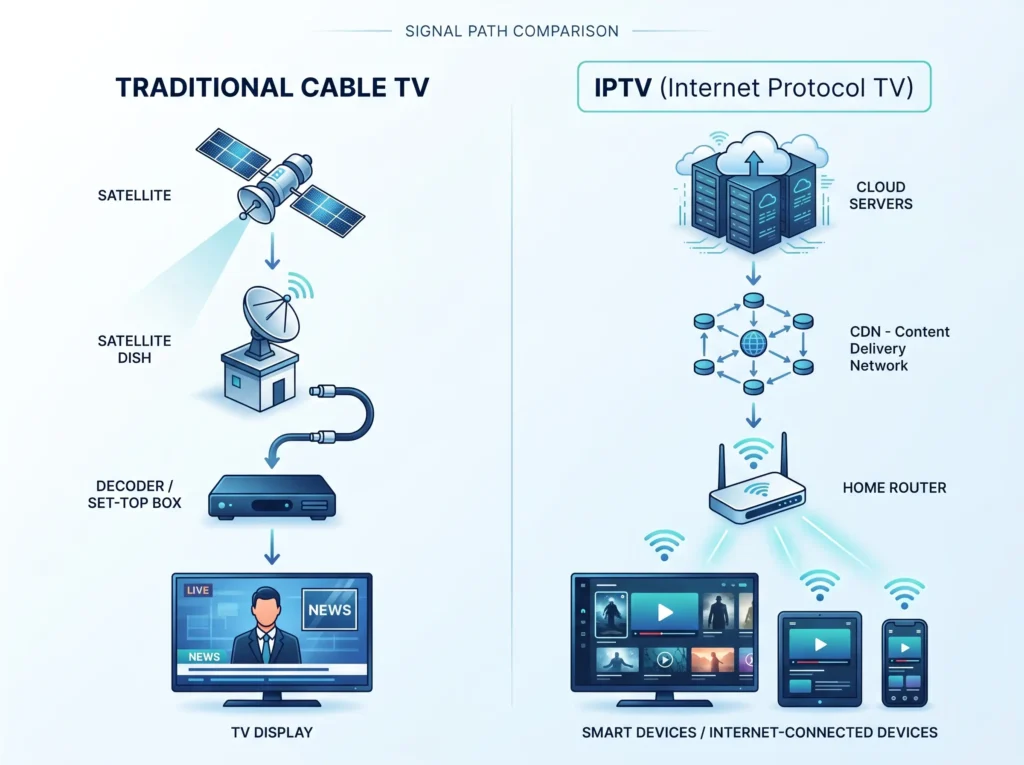
The distinction between legacy media distribution and IPTV lies primarily in the control of the delivery network and the flexibility of the user interface.
Infrastructure Limitations of Legacy Systems
Traditional cable and satellite systems rely on fixed, one-way broadcasting infrastructure.
- Satellite TV: Notoriously susceptible to “rain fade” or environmental signal loss during storms.
- Cable TV: Requires expensive, localized physical infrastructure that limits its accessibility in rural or geographically challenging areas.
- IPTV: Leverages existing global internet infrastructure, making it highly portable. As long as a stable broadband connection exists, the service can be accessed on any compatible device globally.
Financial Disparity and “Subscription Fatigue”
The financial disparity between these models is a primary driver for market migration in 2026.
- Cable Costs: The average U.S. cable bill has reached $127 per month.
- IPTV Costs: Comprehensive global services typically offer access to thousands of channels and massive VOD libraries for between $10 and $20 USD monthly.
Beyond cost, IPTV offers a level of engagement cable cannot replicate, including two-way data exchange for voting, integrated shopping, and personalized advertising.
The Technology Behind the Screen: Servers, CDNs, and Middleware
To understand what is IPTV?, you need to understand its technical architecture. A high-quality IPTV service in 2026 is dependent on a three-tier technical foundation: robust server infrastructure, Content Delivery Networks (CDNs), and sophisticated middleware.
1. Load-Balancing Server Infrastructure
High-tier providers utilize load-balancing servers specifically optimized for regional traffic. This architecture ensures that if a localized server reaches peak capacity during a high-profile event—such as a Premier League final, the NFL Super Bowl, or a global election—the traffic is automatically redirected to a secondary node to prevent buffering.
2. CDNs: The Geographical Backbone
CDNs consist of distributed networks that cache content closer to the end-user.
- Instead of pulling data from a single central server, a user in Paris will stream from a server in France rather than the United States.
- This reduces the number of network “hops,” ensuring ultra-low latency.
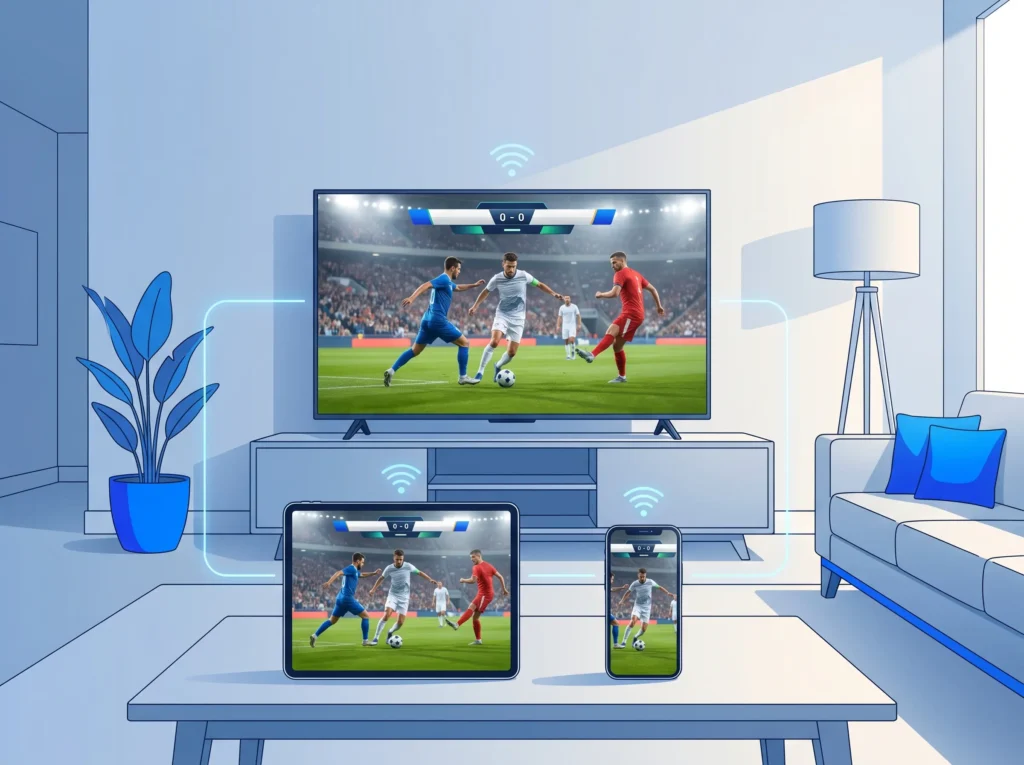
- In 2026, premium services target sub-second latency, which is critical for live sports where any delay can lead to “spoiler” notifications from mobile apps.
3. Middleware: The IPTV Operating System
Middleware manages user logins, billing, the Electronic Program Guide (EPG), and content security. The shift toward cloud-based middleware in 2026 has allowed for 37% faster deployment of interactive features. This includes multi-angle sports viewing, where viewers can select specific camera angles, and real-time social media integration.
The Main Formats of IPTV Streaming Services
In 2026, IPTV content is categorized into three distinct formats that cater to different viewer needs and consumption patterns, important to understand what is IPTV..
Video on Demand (VOD)
VOD is the digital equivalent of a personal media library. Users browse a catalog of thousands of titles, including the latest theatrical releases and television series, which are delivered via unicast streaming instantly upon request. In Western markets, VOD libraries are updated daily, often surpassing traditional TV platforms in both content depth and speed of release. Over 55% of users now prefer on-demand content and AI-based recommendations over scheduled broadcasting.
Time-Shifted TV and Catch-Up Features
This format allows viewers to watch previously aired broadcasts without the need for localized recording hardware like a DVR.
- Catch-Up TV: Features in 2026 typically offer a 7-to-14-day window for users to replay programs exactly as they aired.
- Start-Over TV: This subset allows a user to join a live broadcast in progress and immediately restart it from the beginning.
Live Television Broadcasting (Live IPTV)
Live IPTV remains the primary way 52% of households consume major shared cultural moments, such as real-time news and sports. To maintain stability during massive global live events, providers utilize IP Multicasting. This technology sends a single stream to a group of subscribers simultaneously, preventing local network congestion.
The Global Shift: Why USA and European Streamers are Cutting the Cord in 2026
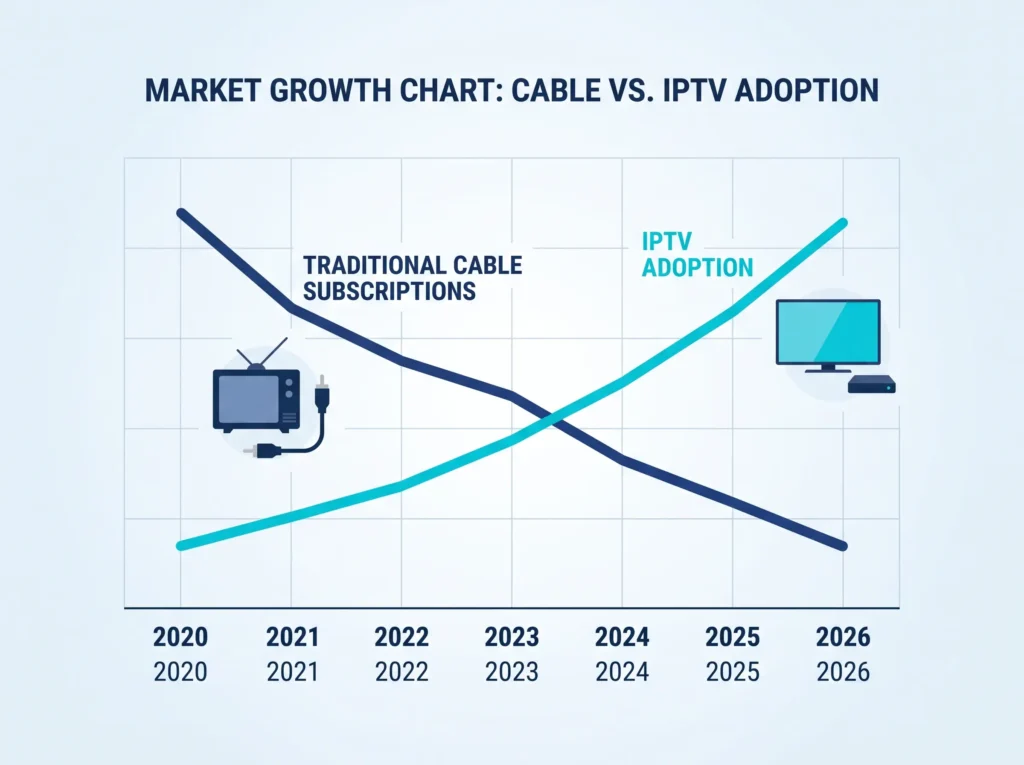
The “Cord-Cutting” phenomenon has transitioned from a trend to a total market realignment.
Statistical Landscape of Cord-Cutting
- USA: Non-pay TV households are expected to exceed 80.7 million by the end of 2026.
- Demographics: 50% of Americans under 32 refuse to pay for traditional cable.
- Market Share: Streaming captured over 50% of all TV viewing on a sustained basis within 2026.
- Europe: In the United Kingdom, traditional TV homes decreased by 1.4 million in a single year, with streaming-only households rising to 62%.
Drivers of Change
- Cost Efficiency: Traditional providers often force “bloated” bundles. IPTV allows users to pay for exactly what they want on a month-to-month basis with no long-term contracts.
- Content Variety: For multicultural populations in the USA, Canada, and Europe, IPTV is the only viable way to access diverse international content (e.g., local news from home countries) alongside major Western networks.
- True Device Freedom: IPTV is hardware-agnostic, supporting smartphones, tablets, laptops, and smart TVs. This mobility is a significant factor for the 42% of U.S. households that have adopted IPTV since 2022.
Essential Equipment: What Do You Need to Stream Internet TV?
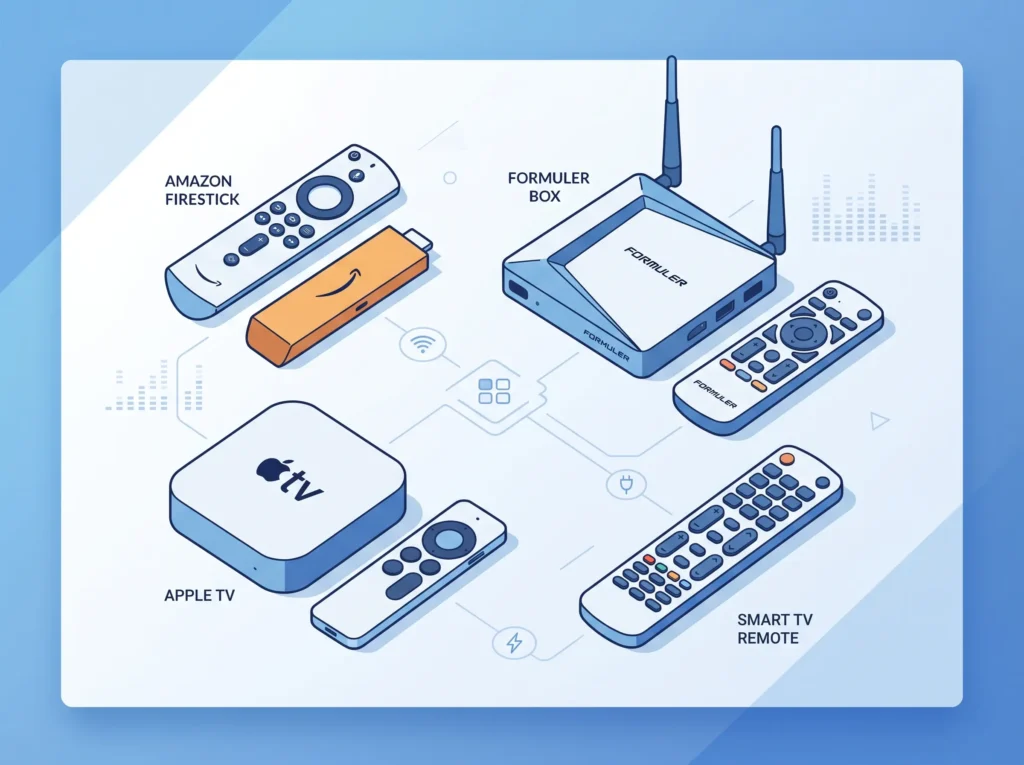
The hardware landscape in 2026 has standardized around high-performance, versatile devices that support third-party applications.
Dedicated IPTV Set-Top Boxes (Formuler and MAG)
Power users often prefer dedicated hardware optimized for zero-latency playback.
- Formuler Z12 Ultra (2026 Flagship): Features a blazing-fast quad-core processor, 4GB of DDR4 RAM, and an unprecedented 128GB of internal storage.
- Connectivity: It includes Gigabit Ethernet, Wi-Fi 6E (AX), and supports Dolby Vision and Dolby Atmos.
- Platform: It runs the MYTVOnline 3 platform, offering universal search and multi-portal support.
Smart TVs and Native Apps
Smart TVs are the primary device for nearly 50% of the market. Most TVs from Samsung, LG, and Sony come with built-in IPTV software, allowing for a “plug and play” setup. These devices support 4K and 8K HDR10+ resolutions natively.
Popular Streaming Devices (Firestick and Roku)
- Amazon Firestick 4K Max (2nd Gen): Features a 2GHz quad-core processor and Wi-Fi 6E, making it an excellent budget-friendly choice for high-bitrate streaming.
- Roku Ultra: Offers a simplified 4K playback experience with an intuitive user interface.
Navigating the Legal Landscape: Is IPTV Legal in the US and Europe?
The legal status of IPTV depends entirely on whether the service provider has obtained the necessary broadcasting licenses.
Verified vs. Unverified Providers
- Verified: Services like YouTube TV, Hulu + Live TV, Fubo, and Sling TV are fully compliant with broadcasting laws, pay licensing fees, and are available in official app stores.
- Unverified: These services often provide thousands of premium channels (e.g., Sky Sports, BT Sport) for a low price but operate in a “grey area” regarding copyright. They are often hosted offshore and may be subject to sudden takedowns.
The Critical Importance of a VPN in 2026
A Virtual Private Network (VPN) is considered an essential component of the streaming stack.
- Privacy: It encrypts the user’s connection, preventing ISPs from monitoring viewing habits.
- Throttling: ISPs often intentionally slow down high-bandwidth video traffic during peak hours; a VPN masks the traffic, ensuring the user gets the full speed they pay for.
- European Regulations: The Digital Services Act (DSA) and the “e-Evidence” regulation (effective August 2026) facilitate cross-border law enforcement access to data, making a VPN a critical security layer for anonymity.
The Business Side: How to Become a Successful IPTV Reseller in 2026
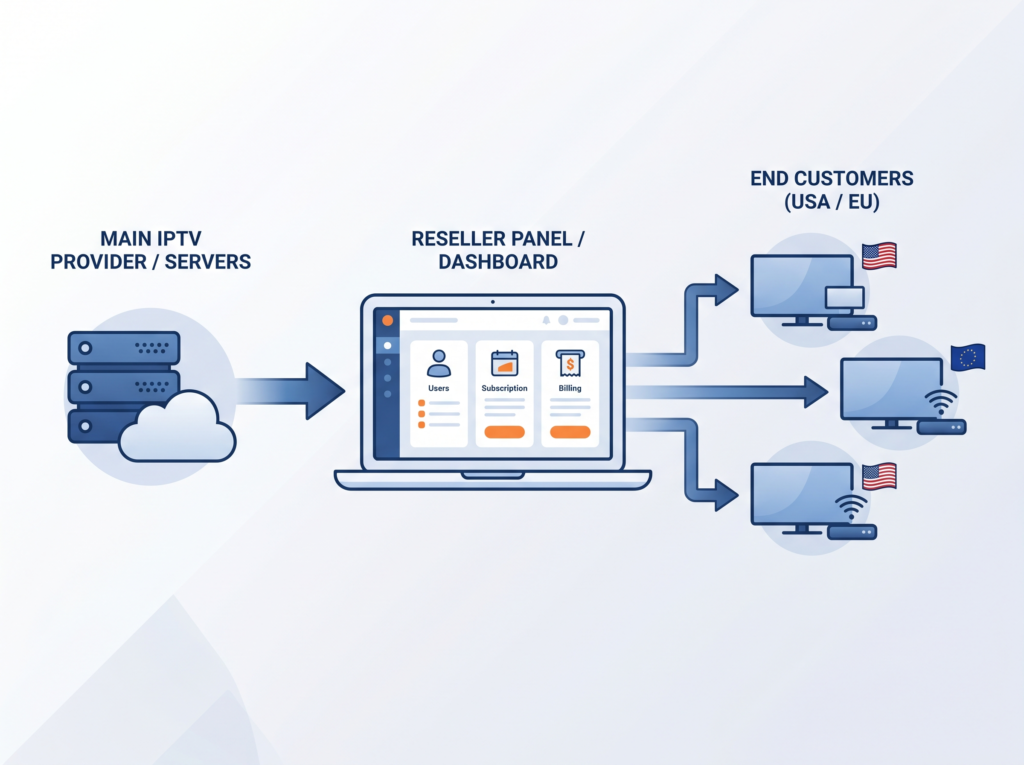
The IPTV market offers significant opportunities through the reseller model. Resellers purchase service credits in bulk and manage their own client base, setting their own profit margins.
The Reseller Panel and Credit System
An IPTV reseller panel is a web-based dashboard for creating customer accounts and activating subscriptions.
- Credits: Generally, one credit equals a one-month subscription for one device.
- Margins: Profit margins often range between 30% and 60%. For example, purchasing a credit for $3 USD and selling a monthly subscription for $12 USD yields a $9 profit margin per customer.
Marketing Strategies for 2026
- Telegram Marketing: This is the “gold standard,” utilizing automated bots and encrypted channels. Native ads in niche Telegram channels can achieve CPMs as low as $0.10.
- SEO and Content: Building trust through educational “how-to” guides on Reddit and niche forums.
- Branding: Developing a private brand identity rather than being a generic seller creates long-term customer loyalty.
Frequently Asked Questions (FAQ)
Can I watch IPTV for free?
Legal “Free Ad-Supported TV” (FAST) services like Pluto TV and Tubi are legitimate but offer limited, ad-heavy programming. Most other “free” links carry high cybersecurity risks like malware.
What internet speed is required?
- 1080p (HD): 10-25 Mbps.
- 4K Ultra HD: Minimum 50 Mbps is recommended.
- 8K Video: Requires 50-100+ Mbps.
What is an M3U playlist?
An M3U file is a text file listing the URLs of media streams. You enter the URL from your provider into a compatible player like TiviMate, IPTV Smarters, or VLC.
Conclusion: The Future of Internet TV
The year 2026 has officially signaled the end of the traditional “box on the wall” era for households across the USA, UK, and Canada. By now, it is clear that what is IPTV is no longer a question of a niche alternative, but rather the recognized global standard for high-definition entertainment.
One vital takeaway is that the transition to an AI-driven, decentralized ecosystem has successfully dismantled the technical barriers—such as buffering and low resolution—that previously limited internet television. Additionally, the industry-wide move toward “super-aggregation” allows you to finally enjoy a unified interface that offers a massive depth of content at a significantly lower cost than legacy cable. As cord-cutting continues to accelerate across North America and Europe, the focus for modern streamers is now on selecting high-performance hardware and stable 5G or fiber infrastructure to maximize these digital benefits.
If you are looking to refine your setup further, your next step should be to audit your home network speed to ensure it meets the 2026 benchmarks for ultra-high-definition streaming. Join the millions who have reclaimed their viewing freedom by making the switch to a more flexible and personal entertainment standard today.